Sunday, 25 June 2017

#30DaysWild day 25 - The pink arrows and a slime mould investigation

The moth trap was out again last night and we had a bumper catch of hawkmoths. They're our favourite moths as they're big and colourful and look a little bit like jet fighter planes. We caught 8 elephant hawkmoths, a privet hawkmoth and a poplar hawkmoth. It seems like the elephant hawkmoths are having a really good year!

Elephant hawkmoth

Poplar hawkmoth

Privet hawkmoth
We put them all on the shed door, so they could fly away when they were ready. A pattern started to emerge, until we ended up with our own night-time aerobatic display team ... otherwise known as the Pink Arrows!
The Pink Arrows

Lined up on the runway


Hawkmoths really are fantastic!


From the beautiful to the not quite so attractive ...

Slime mould may not be the most glamorous thing in the natural world (let's face it, with slime and mould in your name, you're going to struggle to shine), but it's fascinating stuff. When a large yellow sponge-like one appeared overnight on a wooden sleeper in our garden, Bug Mad Girl couldn't resist investigating further.
The slime mould appeared over night in a sleeper
Slime moulds aren't fungi. They belong to a group of single cell organisms that can live independently, but can also group together when food (bacteria, yeast and other microorganisms) become scarce, to form multicellular structures. They can even move en masse in search of food. This is Fuligo Septica , which has the lovely common name of dog vomit slime mould (although I think if my dog ever threw up that I'd be quite worried).
Dog vomit slime mould
Bug Mad Girl cut a little bit off of it so that she could take a closer look under the microscope. The outer crust looked like a sponge and was harder than the oozing 'melted cheese' inside. It dried out surprisingly quickly, turning crusty where it was exposed to the air.
Looks a bit like melted cheese inside!

Crusty outer layer
Taking a good look


During the day the slime mould dried out and gradually turned harder. It will be completely gone within a day or two.
 
I love it that she's so curious about so many different types of wildlife! 

#30DaysWild day 24 - Glowworms

Last night we went on an adventure! We were looking for glowworms, which live on Brush Hill, a chalk grassland slope just above the village where we live. We headed out at 9.30 in the evening and it was still surprisingly bright, which made the walk through the woods slightly less scary!

When we arrived we waited for darkness to fall by admiring the view, drinking hot chocolate and climbing a few trees.
The view at dusk

Best climbing tree on Brush Hill

The hot chocolate went down very well
As it got darker, we set off by torchlight to hunt for glowworms. At first all we could find were slugs and we got a little bit side tracked looking under bushes (you never know what might be under there!)
Getting darker!


The rain earlier in the day had brought the slugs out
What's hiding in there then?
The lights below us were standing out in the darkness, so the time was about right to start looking for tiny green specks of light in the grass.


It took a while, but eventually we were thrilled to find 2 glowworms. You really have to hunt for them, as the glow is tiny and hidden down in the grass.


Glow worms are beetles from the firefly family and it's only the female that produces the green light, from the last few segments of her abdomen. She's completely wingless, so glows to attract the smaller, winged males. She spends two years as a larvae eating slugs and snails, then pupates in a burrow in the ground emerging in June or July. She climbs out of the burrow, glows, mates then crawls back into the burrow to lay her eggs. She dies soon afterwards and is only an adult glow worm for about a week.


We were careful to put them back where we found them, so they could find their burrows again and decided to go home. By now it was 10.30 pm and it was very dark!


The walk back through the woods was 'brisk' as we could hear the trees creaking in the wind and we could feel the eyes watching us. It was a bit scary! Something screeched at us from a tree above us and we could feel the monsters getting closer ...
There were definitely monsters out there!
... but we made it back to the car safely and were home by 11 pm. What a brilliant adventure!

Friday, 23 June 2017

#30daysWild day 23 - Explorers

We decided to go and explore the field behind our house after school today. We played hide and seek in the long grass ...
 
... although the dog can't resist 'finding' and tends to give away everyone's hiding places!


We found a path through the trees around the edge of the field, which led to a secret area with a stream and a little waterfall.

 We looked up and realised we were right underneath a red kite's nest.


Back in the field there were lots of webs full of nursery web spiderlings. Some of them had the parent spider guarding over them. They're pretty big, impressive spiders.


We had a hunt around for bugs and found plenty of meadow browns that were disturbed as we walked through the grass.

Bug hunters

7 spot ladybird

Ladybird pupa

Grasshopper
We found some amazing seed pods that  open by twisting in a spiral. We collected some that hadn't opened yet and we'll scatter the seed in our wildflower meadow (the unmown patch of our garden) when they open.

We ended up making crowns out of grass, which the dog ended up wearing!


Then headed back home.

Thursday, 22 June 2017

#30Dayswild Day 22 - Tiny musk orchids and huge Roman snails

The weather had finally broken and it felt fresh and breezy as I walked around Grangelands and the Rifle Range this morning. The orchids are always fantastic and you can find common spotted, chalk fragrant, pyramidal and the occasional bee orchid out on the chalk grassland. It was another, very special orchid that I was keen to see this morning though. The musk orchid is one of our smallest orchids and is listed as nationally scarce, being found at just a handful of sites in the South East of England.


They're tiny and green, blending in to the grass and other wildflowers. You could easily walk right past them without even seeing them if you didn't know they were there.
Using my finger to show how small they are
They seem to be having a great year this year, as I counted over 100 growing in a small area.


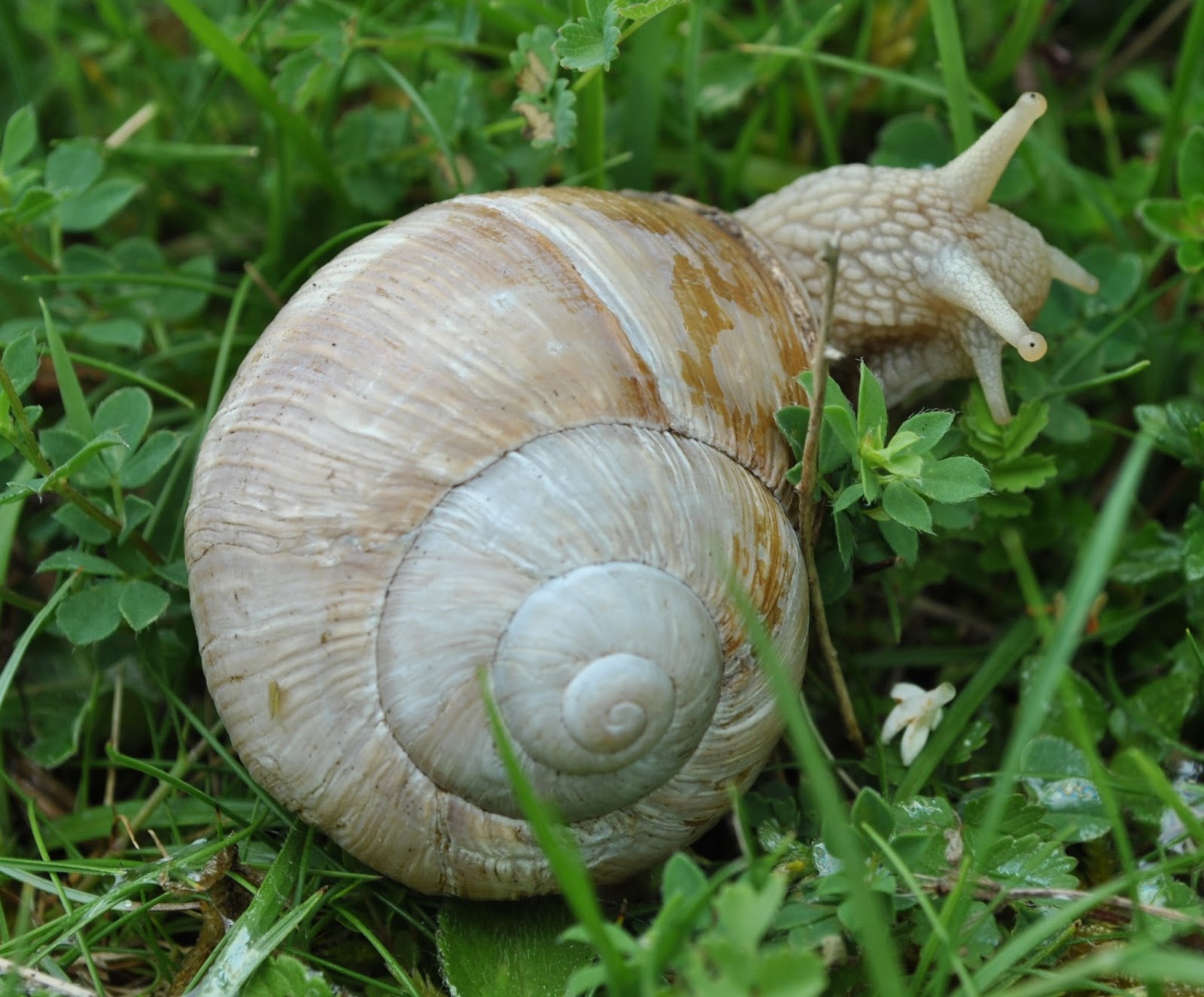
We'd had a few minutes of rain and a rumble of thunder on our walk to school, so I thought there might be some Roman snails around. The rain had hardly made the grass damp though and I only saw one snail braving the dry conditions. They're our largest land snail and their shells are the size of a  golf ball, making them considerably larger than a garden snail. They're thought to have been brought here by the Romans as a source of food and live on chalk grassland along the ancient Ridgeway.

Roman snail