Thursday, 31 August 2017

Heir Island

During our recent holiday to Ireland, we spent three days on Heir Island. 1 km wide and 2.5 km long, it's about as far South as you can get in Ireland and is just off the West Coast of Cork, next to Sherkin Island and Cape Clear Island. It's only a five minute ferry ride from the mainland, but there are very few people (about 25 residents, plus a few day trippers and holiday makers) and only a handful of cars. We weren't quite sure what it would be like, but it was exciting to give and a go and have a look .... turns out it was absolutely beautiful!

The bridge of Paris - the centre of the island and as built up it got!
The scenery was breath taking and we had views across the other islands, right out to Fastnet and the lighthouse.
Cape Clear Island

Fastnet in the distance
We were lucky as there was hardly any wind while we were there, so the sea was as flat as a mill pond. (Not sure it's always like that!)
Down by the bridge of Paris
 
An island across the bay with some windswept trees and a derelict house -
apparently the island is for sale for 1 million euros

You can see the pink tower of Kilcoe Castle (owned by Jeremy Irons) between
the masts of the white boat
Traditionally it was a fishing community and you can still watch the fishermen from the island go out to check their lobster and crab pots each day.
Lobster pots

 
Rusty anchors left up against a wall - they looked like talons reaching
out of the undergrowth
We really enjoyed the peace and quiet and the chance to ramble around and explore the island. The kids swam (in wetsuits, it wasn't that warm!), explored rock pools and scoured the beaches at low tide for shells.
Going for a swim

It was a bit chilly

Low tide treasures
Bug Mad Girl can't resist a rock pool, in fact she likes them best when they're deep enough for her to actually get in them! Her best find was a very strange looking thing that she emerged from the sea clutching.

It was a sea cucumber that was about 25cm long and looked like a black slimy lump of sausage shaped jelly. When she put it in the water it obviously had short tentacles and it had sucker feet that held on to her and a bright orange underside.


Sea cucumbers are related to starfish and sea urchins and apparently you can eat them, but we weren't tempted and made sure it went safely back to the sea!
It was quite a find - she was very pleased with it!
We later found out it was called a cotton spinner, as it can shoot out a string of mucus to deter predators. This crab ran towards it after we had put it back in the water and got caught up in the 'cotton' that the sea cucumber squirted at it.

The 'cotton' can be seen hanging down from the crab
One end of the island ended in steep cliffs, topped by a colourful carpet of gorse, heather and wildflowers.
Heather and gorse
Western eyebright - much chunkier than the Chiltern eyebright we get at home

Lousewort - very pretty
The cliffs were covered in mosses, lichens and flowers.


There were lots of bees up there and we saw a few butterflies and moths.

One of the bees - not very happy about having a camera in its face!

Burnet moth
We found lots of crab claws and shells, where the sea birds had taken them onto the top of the cliff to eat. There were also several little piles of bones, but we couldn't piece them back together to work out what they were.
Bones

Crab claws
There were lots of great birds on the island, but a few stood out. 

The cormorants looked like pterodactyls lined up on the rocks out at sea

Big black and grey hooded crows picked through the mud
and sat on the telephone poles.
Lovely little wagtails
There was a small flock of starlings on the island, that gave us the spectacle of a mini-murmuration each evening. We also heard the curlews and saw them fly over head from one side of the island to the other at dusk. However my favourite birds had to be the masses of swallows that lined up on the telephone wires and dived and swooped all around us.
 

The stone walls were full of beautiful ferns and mosses.


Our evening entertainment was crabbing off the small pier next to the bridge. The crabs can't resist a piece of bacon on a line and hang on tight once they've got it.
Crabbing
Sometimes you can get a lot of crabs on the bacon.
We always put them back in the sea, but they occasionally
get their own back!
 As the sun went down, the views only got better! What a wonderful place!

Saturday, 5 August 2017

Snakes in the grass at the Big Vegetable Show

Our village show was held today, or as we call it, The Giant Vegetable Show. It's usually a good show, so we dodged the thunderstorms and popped up the road for a look. There were plenty of very big vegetables and some odd looking vegetable animals, but the stars of the show turned out to be snakes! It's not every day you see a Burmese python (one of the largest snakes in the world) slithering around a field in Buckinghamshire!


The kids loved holding the snakes and would now like one as a pet. I told them that when they grow up and leave home they can have as many pet snakes as they want!


They were also quite taken with the bosc monitor!


We met a noctule bat called Rose ...


... watched ferrets racing ...


... and spotted the queen bee.


Then the bee keeper donned the outfit and opened up the hive inside a netted area. I've never seen anybody do that at a fair or show before, so it was interesting to see. He puffed smoke at the bees, which I always though made them drowsy. Apparently it doesn't though, as it makes them think there's a forest fire. Then they dive into the hive and eat as much honey as possible, ready for a hasty escape. That gets them deep into the hive makes them so full that they can't bend their abdomens round to sting anybody.


Mustn't forget the vegetables!

Very odd vegetable animals

Enormous cabbages and courgettes
We also saw some very badly behaved dogs. They were supposed to ignore the sausages and squeaky toys all around them and go to their owner when called, but almost all of them couldn't resist the tempting treats, which was very funny.

Then the little one met the mayor, which seemed to make his day. He even wiped the ice cream from his face before saying hello!


 What a great show!

Monday, 17 July 2017

A chalkhill, white-letter, dark green morning

I stood at the top of a Grangeland slope this morning and there were so many chalkhill blues fluttering through the short grass that I hardly knew where to look. I'd focus on one that had briefly settled and another would flutter past and distract me. It was such an amazing sight to see the short grass slope shimmering pale blue as hundreds of them flittered and danced! Not a bad problem to have, but it did make my head spin slightly!!


Chalkhill blue


Chalkhill blue
I didn't think things could get much better than that, but then I spotted a little brown butterfly that looked a bit different. As I got closer I almost dropped the camera when I realised it was a white-letter hairstreak. It's the first one I've ever seen at Grangelands and I was thrilled when I saw the distinctive white 'W' on it's hind wing and realised what it was. It was a bit tatty, but I don't mind!

White-letter hairstreak, showing the white 'W' on its hind wing 
 
White-letter hairstreak
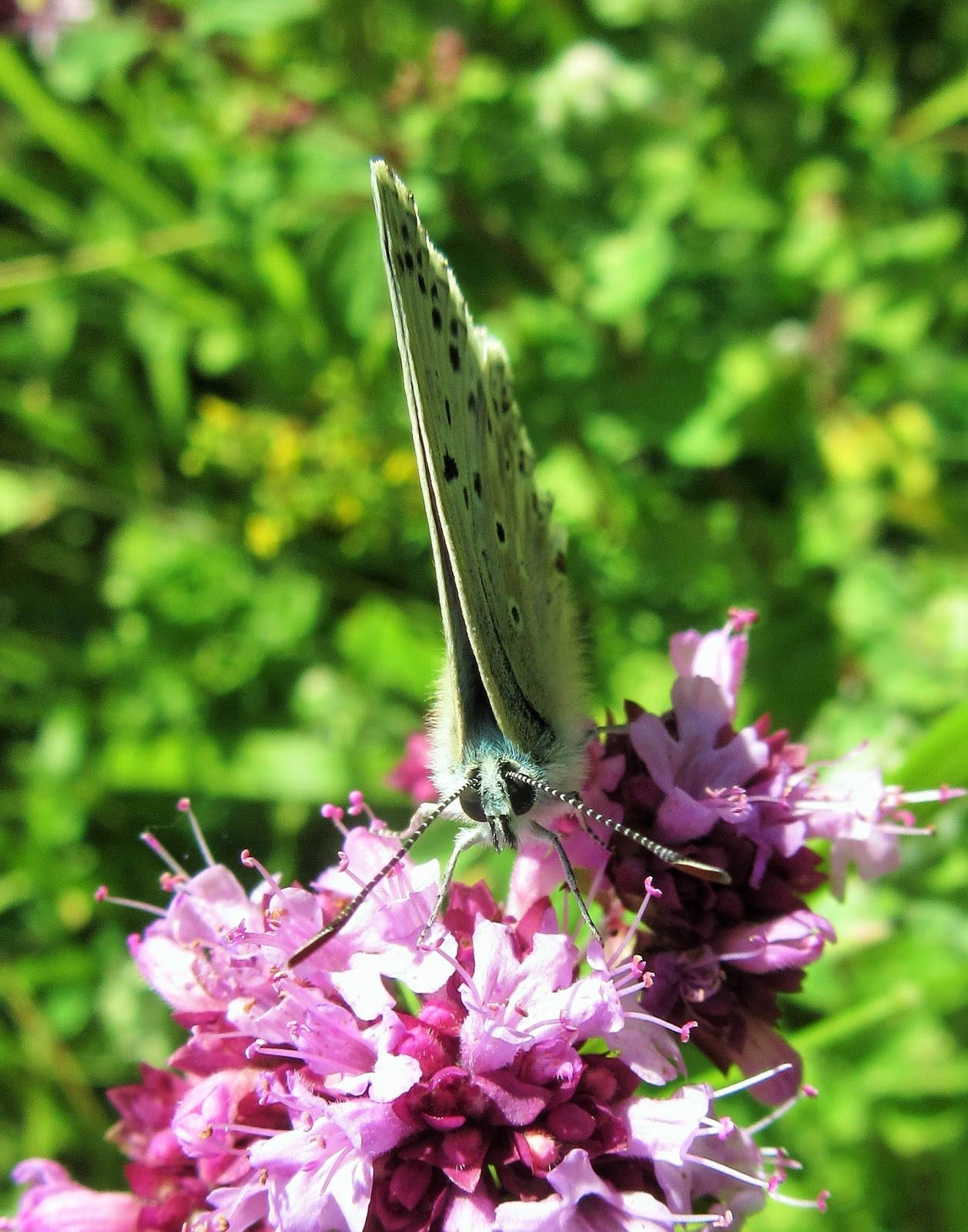
There were butterflies everywhere, loving the wild marjoram and the sunshine. I got carried away following marbled whites, common blues and small skippers and trod in a rabbit hole, turned my ankle over and put my hand down on a thistle. It really hurt! As I sat there picking prickles out of my fingers, a dark green fritillary settled next to me. It was chased away by a meadow brown, but was back within a few minutes to almost the same spot.

Dark green fritillary
What a wonderful morning! As I walked back, there were brimstones, gatekeepers and meadow browns and I saw a comma and red admiral when I was almost back at the car park. Another beautiful morning at Grangelands!

Brimstone

Comma

Red admiral

Friday, 14 July 2017

Red kite tumble

We've had a bit of a drama with the red kite's nest in my parents back garden.
The smaller of the two chicks, a couple of days ago
The smaller of the two chicks fell out of the nest at some point Tuesday night or Wednesday morning (when it was very rainy and chilly). He was found sitting in the middle of the lawn, looking very wet and cold.

He looked very sorry for himself as he was soaked through and was too young to fly, so wouldn't have been able to get back up into the nest. He was a 'sitting duck' and the neighbours cats were already lurking in the bushes, so Mum carried him indoors and he sat on their kitchen table while they tried to decide what to do with him. One foot seemed to have been damaged in the fall and he wasn't using it at all. Later that morning the sun came out, so they put him on a bench on their patio to warm up and his parents both came and sat in the nearby trees and 'talked' to him.  

My parents called Tiggywinkles, which is a very well known wildlife hospital only 15 minutes away from them, to ask what to do with him. They said to bring him in and they'd make sure his foot was OK, give him pain killers if needed, then look after him until he was old enough and strong enough to be released. If he had damaged himself so badly that he couldn't be released, they'd care for him permanently.

All a big sad really, but at least he has a chance of making it back to the wild. He will probably be able to fly within about a week, so fingers crossed he makes it.

Unfortunately I missed the whole thing, as I was out all day on a school trip, so I have no photos of the drama!

The older chick is doing well and the parents have been trying to encourage him to fly around the garden. He flies from one tree to another, then goes back to the nest for a snooze and some food. He spends the rest of the time sat on one of the branches outside the nest. Won't be long now until he flies off for good.
The elder of the two chicks

Wednesday, 12 July 2017

BBC Wildlife photo of the week

I was thrilled to find out that one of my photographs is BBC Wildlife magazine's photo of the week.


We looked after some small tortoiseshell caterpillars over 30 Days Wild, that we watched pupate. This picture was taken when one of them hatched out about a week and a half later. The blog post with more photos and a video of the moment one hatched can be found here.

Thanks BBC Wildlife!